- 20.04.2026.
- News
The first Adriatic Nautical Business Forum 2026 was not just another event in the industry calendar. It was a test. A test of the willingness to finally speak openly about problems everyone knows, but few actually say out loud. And more importantly, it was proof that the interest exists.
ANB Forum 2026 did not open new questions. It opened questions that the industry has known for a long time, but too often pushes aside.
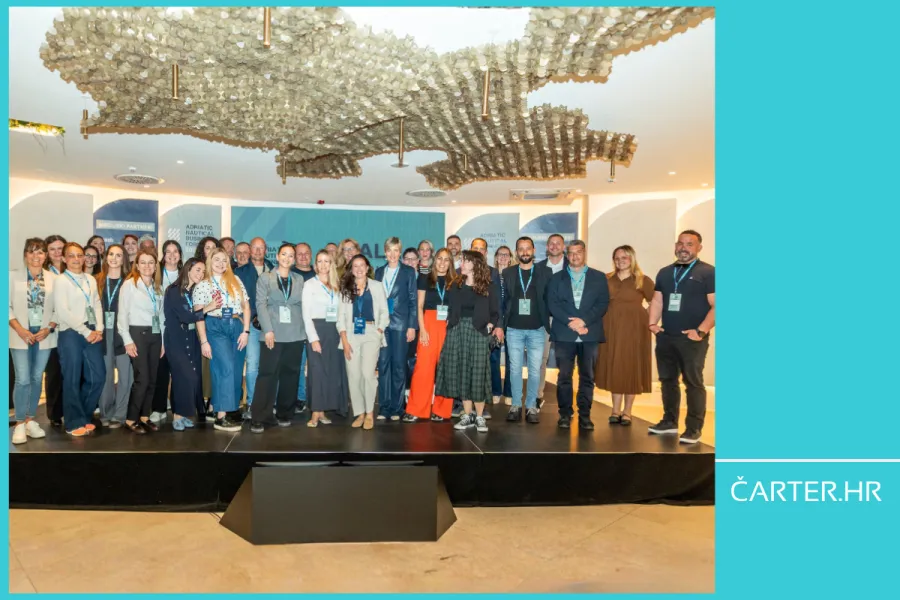
The first Adriatic Nautical Business Forum brought together yacht charter companies, marinas, brokers, institutions, operations and other stakeholders in the sector, but its greatest value was not in the gathering itself. The value was in the fact that, in one place, topics that are usually discussed separately began to connect: quality, standards, responsibility, improvisation, seasonal pressure and the fact that a destination cannot be strong if each of its parts operates by its own rules.
For those who were there, ANBForum confirmed that the industry needs more mutual dialogue and fewer parallel realities. For those who were not there, the fact remains that they missed being part of a conversation that does not concern just one event, but the everyday functioning of the industry: service standards, operational limitations, shared responsibility and the question of whether a destination can be of high quality if each of its parts operates by its own rules.
This is not a summary of the programme, but a cross-section of what became clear that day. Through presentations, discussions and comments from the audience, several points stood out that the industry can no longer easily ignore.
1. Quality as potential exists, but the standard as a system has not yet been defined
Croatian nautical tourism has quality. This is no longer a topic of discussion, but a starting point. However, the problem arises when that quality is neither consistent nor structured through clearly defined standards.
In practice, this means that the guest experience still depends on a number of individual factors, from company to company, from marina to marina, from team to team. In such an environment, premium is not built systematically, but appears in fragments, often as a result of individual effort rather than an organised approach.
A destination that wants to communicate a premium position cannot afford such a level of variability in the long term. Without a shared understanding of what quality is, how it is measured and how it is maintained, any further ambition remains limited.
2. A nautical destination as a unified system requires balanced participation of all stakeholders
One of the key insights that ran throughout the entire forum relates to the perception of the destination. The guest does not distinguish between the operational boundaries of the industry. For them, there are no separate systems, but one unified experience.
For this reason, the question of responsibility cannot be selective. Yacht charter companies, marinas, agents, institutions and everyone involved in the value chain all participate in shaping the final impression. Every weak point in that chain directly affects the perception of the destination as a whole.
The forum opened space for a more realistic view of this dynamic. Instead of expecting change to come from outside, more emphasis was placed on one's own role within the system. This is a shift that the industry must make if it wants to speak about sustainable quality.
3. Alignment between the industry and institutions is only possible through continuous and meaningful dialogue
One of the fundamental goals of the forum was to bring the perspectives of the industry and institutions closer together. However, it became clear that a formal gathering alone is not enough. The key difference emerges when the conversation becomes concrete.
When operational challenges are addressed instead of general statements, when real experiences are shared and when there is a willingness to question one another, dialogue gains real value. Without this, alignment remains declarative.
It is particularly important that topics which are often left unspoken were opened, from the differences between defined standards and their implementation, to the limitations brought by the peak of the season. These are precisely the kinds of conversations that create the foundation for real solutions.
4. The relationship between standardisation and operational flexibility in the context of peak season
The question of standards cannot be viewed in isolation from the reality of operational work. The nautical industry operates in a highly dynamic environment, where a large number of decisions are made in real time.
In this context, improvisation has long been perceived as an advantage. The ability to react quickly and adapt often saves situations and ensures continuity of service. However, the forum clearly demonstrated the limits of such an approach.
When improvisation becomes the dominant model of work, the standard loses its function. Quality ceases to be predictable, and the guest experience becomes dependent on individuals rather than on the system. During peak season, what is tested is not technology, but processes and people.
This is exactly where standardisation gains its true value, not as a limitation, but as a support.
5. The need for a structured space for industry dialogue beyond formal frameworks
One of the most valuable dimensions of the forum was not related to the official programme, but to the interaction among participants. Conversations outside the stage, questions from the audience and spontaneous comments often opened topics that deserve further development.
This points to a clear need within the industry. There is interest in exchanging experiences, comparing practices and opening questions that do not have simple answers. However, such a space rarely exists in a structured form.
If the industry wants to move forward, such conversations cannot remain occasional. They must become continuous and directed towards concrete conclusions.
ANB Forum as a potential platform for articulating shared directions of development
The value of this forum lies not only in its first edition, but in its potential. If it remains a one-time event, an opportunity for a more significant step forward will have been missed.
If it develops into a platform that continuously brings the industry together, it can take on a role that is currently missing, the role of a place where not only opinions are exchanged, but directions are shaped.
In an industry facing market changes, rising guest expectations and increasingly strong competition, such a platform is not a formality. It is a necessity.
In conclusion, the question that remains
For everyone who was there, this forum opened more questions than it provided answers.
For those who did not attend, perhaps the more important question is:
How much can the industry afford not to take part in such conversations?
Because if the conclusions are reduced to individual attempts at improvement, nothing substantial will change.
But if they become a shared direction…
then this was only the first, but a very important step.
Categories of trends
- News
- Sale
- Marketing
- SEO
- Web design
- Social media
- Technology
- Regulations
- Management
- Education
- Finances
- User experience
- Graphic design
Newsletter
Sign up for the newsletter and receive the latest trends and tips straight to your inbox