- 26.01.2026.
- News, Management
When a guest sends an inquiry, everything seems promising, they’ve shown interest, provided all the information, and it looks like the booking is as good as done. But then – nothing. No response or reaction. Why? Because the decision to book doesn’t come down only to the price or the type of yacht. The impression you make right from the start also matters.
If you’ve been in yacht charter long enough, this scenario is probably familiar. An inquiry arrives via email, contact form, or WhatsApp. The potential guest is looking for a boat, provides a few basic details, you reply… and nothing. No response, no follow-up questions, no booking.
The question is: where did they "disappear"?
In most cases, you’re not the only one the guest contacted. Given the number of online listings and aggregators, guests today reach out to multiple yacht charters in a short time.
And you’re just one of them. If your message wasn’t quick, clear, and didn’t offer a solution right away, they move on.
What you can change is how you respond to the inquiry, how quickly, in what tone… It’s important to anticipate the needs of a guest who hasn’t even decided yet if they want to book a sailing yacht or a catamaran. Sounds simple, right?

What does a guest expect when they send the first inquiry?
Your potential guest will not book immediately after the first contact. Even though they’re looking for a yacht, they’re actually seeking much more – a sense of security, the feeling that you’re reliable and open to cooperation.
They rarely say that directly, but their behaviour shows it. How quickly they (don’t) respond and the type of follow-up questions they ask all reveal how comfortable they feel in the communication.
At the moment they send an inquiry, they are just seeking information, checking options, or trying to understand what yacht chartering even involves.
Often they don’t have enough experience or aren’t sure what they should be asking, so they expect someone on the other side to guide them through the process.
At that moment:
- They don’t have all the information.
They roughly know what they want – a yacht in a certain period and number of people – but they’re unsure about details such as embarkation, terms, insurance, or technical specifications. - They aren’t sure who is reliable.
The yacht charter market is large, and a website can look good even if there isn’t a real company behind it. That’s why the guest will look for confirmation that they’re dealing with a serious yacht charter – and that’s why both grammar and response speed are equally important. - They don’t know who’s running the business.
Many don’t understand the difference between a broker and a direct yacht charter. If you don’t clearly explain that to the guest, they may get the impression that “no one knows who’s responsible”. - They’re comparing (not just boats, but communication too).
If a guest sends an inquiry to five different companies, they’ll get at least five responses. They won’t only look at the best price – they’ll also pay attention to who replied quickly, who asked additional questions, who explained things best and provided the most useful information.
That’s why your first reply must be much more than: “Here’s our price list, here’s a link.”
The guest wants to feel like they’re talking to a real person, but without pressure. Someone who knows what they’re doing but doesn’t push the booking right away.
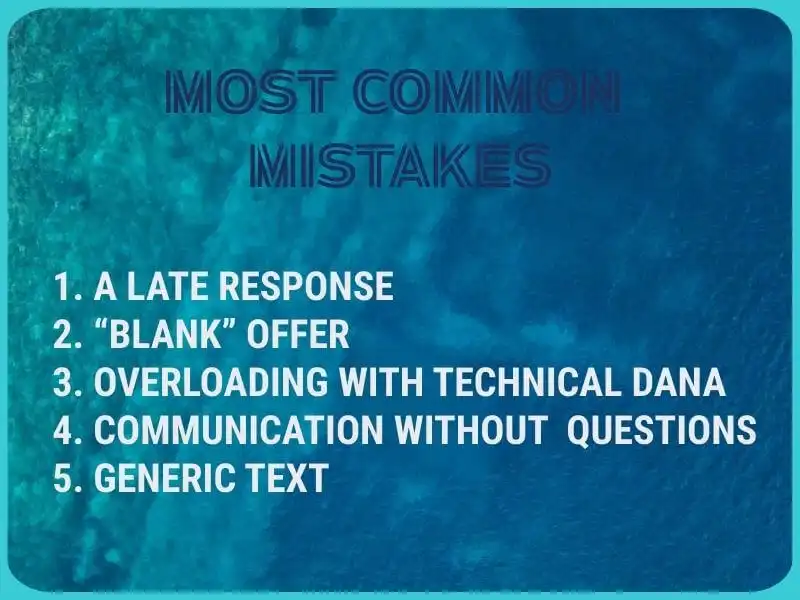
The most common mistakes (that end communication before it even starts)
When a guest sends an inquiry, they still don’t know exactly what they want, but they do know how they want to be treated.
That’s exactly why the first two sentences you send often decide whether the guest will contact you again at all. And this is where mistakes happen most often.
1. Late response (more than 12 hours)
If a message sits unanswered for more than half a day, there’s a high chance the guest has continued communication with the competition or even booked elsewhere. Response speed doesn’t have to mean a fully prepared offer right away, but the guest needs to know they’ve been noticed and that someone is working on their inquiry.
How to fix this:
An automated inquiry confirmation using tools like Brevo or Mailerlite: “Thank you for your inquiry, we are currently checking availability. You can expect a response within a few hours.”
Internal CRM reminders (e.g. Pipedrive, HubSpot) so that no inquiry remains unanswered.
2. “Blank” offer with no personal approach
“Dear Sir or Madam, please find the offer or price list attached.” is not a message that encourages conversation. That’s something accounting would send, not a yacht charter company that needs to sell a week-long holiday at sea.
Instead:
An opening sentence that shows you’ve read the inquiry: “We see you’re interested in sailing in July with 4 adults and two children. Here’s a yacht that could suit you.”
A closing line that encourages further communication: “If the dates work for you, we can check whether there’s an option for an early booking discount.”
3. Overloading with technical data without context
Hull length, engine power, tank capacity, all of that information should be available, but it’s not how you open a conversation. The guest wants to know if they can board easily with children, whether there’s enough space, if the yacht is easy to handle, and who will welcome them at the base.
How to approach this better:
Combine basic technical data with a short description of practical experience:
- “This model is especially popular with families because it has a separate master cabin in the bow, as well as a large fridge and water tank.”
- “In the equipment list you’ll see solar panels and a bimini, which is useful during hot summer days when you’re often at anchor.”
4. Communication without a single question for the guest
If you don’t ask a single follow-up question in your reply, the guest gets the impression that you don’t really care. And without questions, you can’t know what they’re actually looking for. Maybe their dates aren’t fixed. Maybe they don’t even know the difference between a catamaran and a sailing yacht.
Examples of questions that show engagement:
- “Is a master cabin with a private bathroom more important to you, or more space in the saloon?”
- “Will you be sailing on your own, or do you need a skipper?”
- “Do you plan to spend more time in marinas or at anchor?”
5. Generic text that doesn’t sound like a real person
Guests very quickly recognise texts that have been sent to hundreds of other people. They delete those messages without even opening your offer.
They simply feel your reply isn’t important, because it seems they aren’t important to you either, if there’s no clear communication tone or if they don’t get the feeling you genuinely want to help.
How to avoid this:
Use a CRM system (e.g. HubSpot or Zoho CRM) that allows personalised templates: the guest’s name, requested dates, and yacht type are automatically inserted into the message.
Add a human tone, not overly formal language.
Example: “We have this catamaran in our base at Marina Dalmacija in Sukošan, and it’s most often booked by families with children. If you’re interested in a specific route as well, we can send you a suggestion.”
Good communication doesn’t mean long messages. It means responding on time, clearly and personally.
A reply that’s sent quickly, written person to person, and includes questions that show you care about who’s writing to you and what they want is what guests notice. And when a guest feels that someone on the other side is genuinely interested, a booking is never far away.
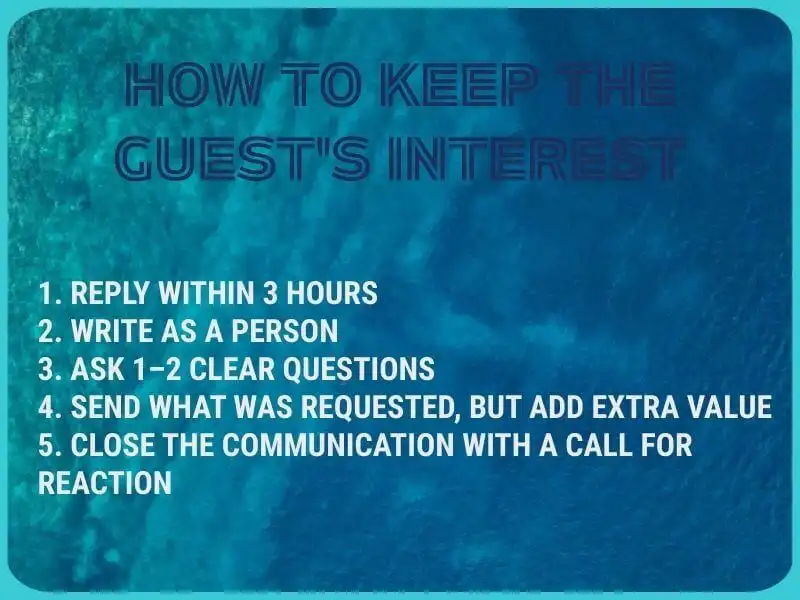
How to keep the guest's interest after the first contact
The first reply is not just a chance to overwhelm the guest with information, it is the beginning of a relationship. If you want a booking, you need to give them a reason to stay in the conversation. Here’s what helps:
1. Reply within 3 hours if possible.
Speed shows professionalism. If you don’t have all the information right away, send a short message:
“Hello! Thank you for your inquiry, I’m checking the yacht’s availability and will send the details within an hour. If you have any other questions, feel free to write!”
2. Write as a person, not as an automated system.
Add a bit of a personal tone:
“I see you’re looking for a yacht for two adults and two children. In our yacht charter, we have an option that could be perfect for you.”
3. Ask 1–2 clear questions.
This opens up space for further conversation:
“Have you sailed from Biograd before? Or would this be your first time?”
4. Send what was requested, but add extra value.
Don’t overwhelm the guest with five similar yachts unless they specifically asked for that. If you do offer more options, explain why:
“The yacht you asked for is unavailable, but we have a very similar model with a shallower draft, which is useful if you’re planning to sail south.”
5. Close the communication with a call for reaction.
Don’t finish with “Let us know if you have any questions.” Instead, write:
“Can I hold this option for you until tomorrow morning while you think about it?”
What if the guest doesn’t respond at all?
The worst move is to do nothing. Most bookings don’t happen after just one message exchange. If the guest doesn’t respond within 24–48 hours, it’s time for a gentle follow-up.
Here are a few examples that don’t sound pushy:
- “Just checking if you had a chance to review the offer. Feel free to let us know if you have any questions or need something different.”
- “The offer we sent is still available, and if you need more information, we’re here.”
- “If you haven’t decided yet, we can suggest more flexible options, no obligation.”
Important: don’t repeat the same message. Every message should have a purpose. You can add new information, a sample route, an offer for a different date, or a seasonal discount if it’s currently available.
How to stand out among dozens of other yacht charters?
Most guests receive messages and replies that sound the same. If you want to be remembered, be a little different – not in a marketing way, but in a human way.
Examples of what you can add:
- A short description of the skipper (if offered as an option).
- Suggested best route for their dates.
- Airport transfer service.
- Information about local events.
- Early booking discount (if it’s real, not made up at the end).
These are all specific reasons why a guest will choose you over someone else.
The role of CRM and organisation in keeping leads
If you handle everything "by hand", it’s easy to forget who asked what and when.
That’s why you need a CRM (Customer Relationship Management), which doesn’t have to be expensive or complicated.
It’s enough to have:
- A list of all inquiries with basic details.
- A record of when you sent the message.
- Reminders for follow-up.
- Status of each inquiry (pending, in progress, booked, inactive).
And most importantly, let the CRM remind you when it’s time to follow up.

Every communication with a guest is a chance to make a good impression
You already know your guest isn’t only looking for what to sail. They’re looking for someone they can trust to make sure everything goes well, from the first agreement to returning to the marina.
Your first contact is the moment they decide whether you are that someone.
Fast, clear, and human communication focused on what the guest truly wants is what sells.
If you learn to treat every inquiry as the start of a conversation, not just a price request, you’ll make your job easier and your season better.

Categories of trends
- News
- Sale
- Marketing
- SEO
- Web design
- Social media
- Technology
- Regulations
- Management
- Education
- Finances
- User experience
- Graphic design
Newsletter
Sign up for the newsletter and receive the latest trends and tips straight to your inbox