
- 16.09.2026.
- Sale
Premium business does not begin with price but with well-organized processes. Andreja Fazlić explains why CRM, quality data, and clear standards are the foundation of a better customer experience and a prerequisite for the meaningful use of AI.
In the previous article, I wrote about how AI will turn your business into kitsch if you introduce it while standing on shaky foundations. And shaky foundations in business mean that you lack solid fundamentals: strategy, brand, design and processes that connect marketing, sales and support into a unified customer experience.
And finally, what all of this rests on in everyday work - CRM. A place where your data is organized, clean and connected, instead of scattered across Excel sheets, emails and other people's heads.
I ended the previous article with a promise that I would tell you where the journey to becoming premium actually begins. The answer is logical and was mentioned just a moment ago, it begins with the foundations. But before I explain the details of the solution, let us be honest about where most businesses really stand today.

Do you recognize yourself?
You manage sales from memory and off the top of your head. Each team member does it their own way; one in a notebook, another on their phone, a third in their head.
You still welcome a customer returning for the third time as if you were seeing them for the first time. The offer you sent two weeks ago never received a response, and no one remembered to pick up the phone and ask - where did things get stuck, is there anything else we can do to help? Marketing launches a cold email campaign to a customer whom sales is already speaking with - and because of that, the customer feels as if they are talking to two different companies. Not exactly premium, is it?
You do not know how many inquiries you receive each month, how many fall through and, even worse, where and why. When someone asks you how the last quarter went, you spend half the day searching through spreadsheets for the answer or simply come out with some generic phrase like - Well, it was good, I can't complain.
And when someone leaves the company, their customers, agreements and half of what they knew leave with them. Because everything they did was never recorded anywhere except in their head.
You may have even purchased a CRM, but it sits empty because no one has time to fill it in. Or everyone fills it in in their own way, so the data is of no use anyway.
If at least one of these situations sounds familiar, the diagnosis is clear - you have a problem with the foundations of your business.
Why CRM before AI?
First, let us clarify what CRM actually is, because most people think it is software. It is not. CRM (Customer Relationship Management) is first and foremost a way of thinking that places the customer at the center of all your processes, while the software is simply a tool that supports that way of working.
As a system, it connects data from marketing, sales and support into a single view of the customer. Through it, you track, understand and improve every interaction with them, and make decisions based on real, coherent and consistent data rather than assumptions.
And this is precisely where the connection with the previous article lies: AI is only as good as the data you feed it. And that data lives in the CRM. Without it, the only thing you can give AI is chaos. And it will return it to you in a bigger and prettier package. That is why CRM comes before AI!
But this is not solved simply by purchasing a license. That is the easiest and least valuable part of your business's digital transformation. What makes it the reinforcement of your foundations is deciding what you track in it and why, who does what and in what order.
And a foundation like that cannot be bought with a click. It has to be drawn out, and that process of drawing it out is at the heart of my CRM strategy service. Its first step, the one in which the actual blueprint is created, is called a sprint.
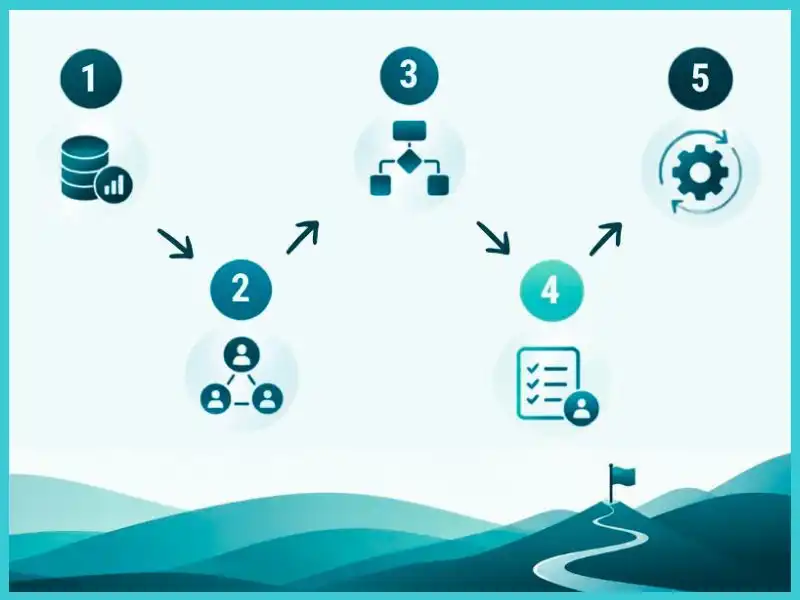
What is a CRM strategy sprint?
It is a working process in which we map and document your system together, around the tools you already use or are only planning to introduce into your business. Each meeting has its own purpose and topic, and the sequence is defined:
- First meeting - data architecture. What you actually track and why. Because reporting is not “we measure everything”, but “we know which numbers lead us to a decision”. We start from the end: which decisions do you want to be able to make and which numbers do you need for that. This is where the logic for everything that follows is established.
- Second meeting - specifics. A customer is not just one type of contact; you have different groups of people with whom you build different types of relationships in your business. Not all of them are customers, and you may also have different groups of customers themselves, with different sales processes. Here we define contact types, field types and what is tracked for whom. It may sound like a small detail, but these details and definitions determine whether your system will work or not.
- Third meeting - sales processes. We map the journey of each type of customer, the pipeline and the stages of that sales process - the way sales actually happen. This is usually the first time you see your sales process written down in one place, and this is where the points at which inquiries get stuck or disappear become visible.
- Fourth meeting - SOPs. For the key stages of the process, we define who does what, when and according to which standard. Because being premium means having a standard! Standard operating procedures make the difference between a company where every new person learns the job by picking things up as they go, and a company where the system guides people, and where work does not come to a halt as soon as someone goes on holiday or sick leave.
- Fifth meeting - automations. Only at the end, once we have put the basic reinforcement in place, do we look at what makes sense to automate, where, and what does not. Because automation on top of a disorganized process is not realistic, and the only thing it does is create even more disorder. This is also where the story of AI comes back in - because it too is a type of automation for which the same rule applies: it only makes sense when there is something concrete underneath it.
What are you left with?
The entire architecture, definitions, processes and SOPs are documented in a shared document that you ultimately take over. And it is not created in a meeting, but in your real business - between meetings, you test what we have set up together, and at the next one we adjust what has been put in place according to what actually worked.
That is the point. You will not get a polished presentation from me, but a practical document that is yours, that you understand because you built it with me and that continues to function without me. What you paid for, you can use on your own as well, because the foundation has to be yours. How you build on it from there, independently or with support, is another story.
Who does the sprint make sense for, and who is not ready for it yet
It makes sense for someone who has outgrown “everything is in my head” and feels that the lack of organization is starting to cost them: missed opportunities, lost hours and people who leave and take knowledge with them.
It does not make sense for someone who does not yet have customers or processes. CRM organizes what exists, not what does not. First you need business, and only then a system.
If you are in the first group, get in touch for a no-obligation conversation to see whether the sprint is the right step for you.
It is important to know that reinforced foundations are not a house. From there, the path can lead in two directions: to your most beautiful home or to expensive concrete where no one lives. The difference lies in whether people will actually live in that house. That is the work of the second phase of the CRM strategy service - adoption.
I will write about that, and about the most expensive mistake that arises there, in the next article.

Andreja Fazlić
Andreja Fazlić is the founder of the consulting agency Astarta: Bit, which operates at the intersection of marketing, sales and business development through the Inbound methodology. Regardless of whether she introduces novice entrepreneurs to the world of digital business, marketing and sales, or collaborates with already developed organizations in the transformation of their business, she helps her clients systematize, organize and implement tailor-made solutions that enable them to more easily adapt to market changes and consumer habits, while at the same time achieving higher revenues and a more stable position on the market.
Categories of trends
- News
- Sale
- Marketing
- SEO
- Web design
- Social media
- Technology
- Regulations
- Management
- Education
- Finances
- User experience
- Graphic design
Newsletter
Sign up for the newsletter and receive the latest trends and tips straight to your inbox