- 16.12.2024.
- News
Key challenges such as high marina costs, price dumping, unfair competition, and insufficient promotion of nautical tourism by regional tourist boards are the reality for Croatia's yacht charter industry. Below, explore the results of an anonymous survey as well as concrete initiatives for creating a fairer, more competitive market and ensuring the quality development of Croatia's nautical tourism.
Croatia, with over 1,000 islands, crystal-clear seas, and a rich nautical tradition, is naturally positioned as one of the most desirable destinations for nautical tourism in the world. However, behind this shiny image lie deep-rooted problems that have plagued the yacht charter industry for years.
A recent survey among yacht charter companies, organized on the charter.hr platform, revealed key challenges threatening the sustainability and competitiveness of the sector.
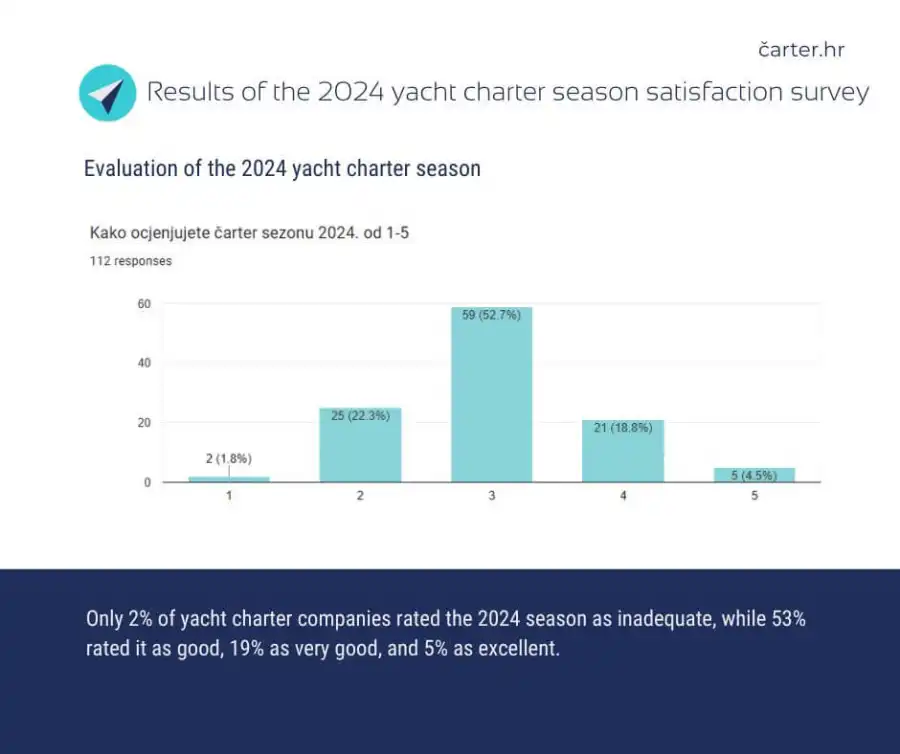
Between October 29 and November 11, 2024, we conducted an anonymous survey among Croatian yacht charter companies about their satisfaction with the 2024 yacht charter season, aiming to identify the key challenges, priorities, and trends in the nautical charter industry for the season. Below, we present the main conclusions and guidelines that we see as opportunities to improve the industry.
High costs, low service quality
One of the most frequently mentioned issues in the survey was the unjustifiably high costs of marinas and berths, which, according to respondents, are not matched by adequate service quality.
"Marina prices rise every year, while sanitation facilities and basic services stagnate or even deteriorate. Guests complain about the poor value for money, which discourages them from returning."
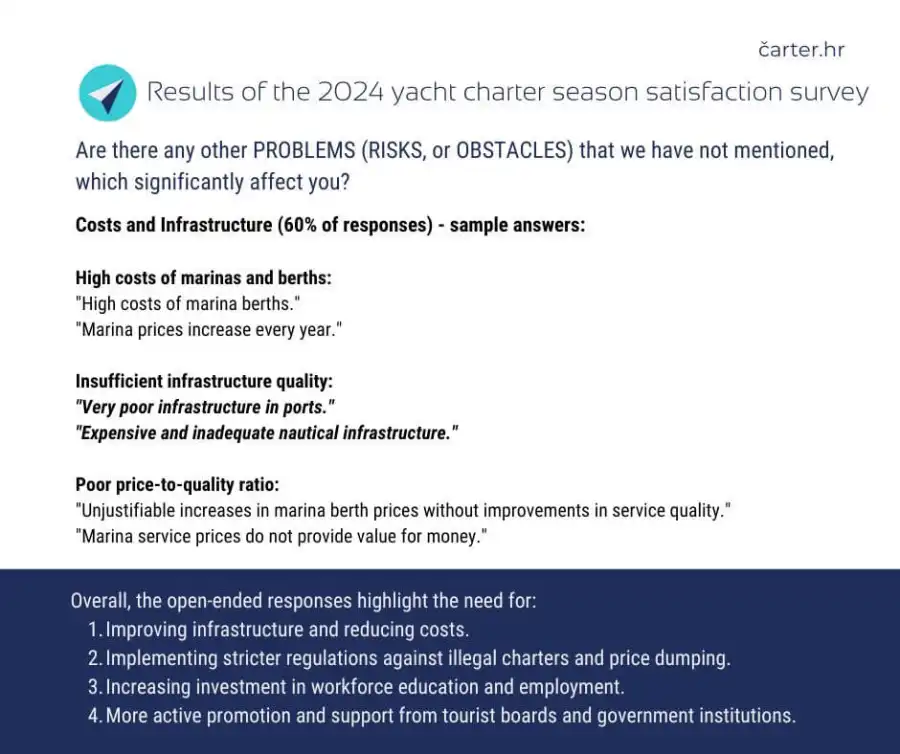
This dissatisfaction is not just a matter of perception. The rising prices of marinas and services, without corresponding quality upgrades, directly impact guests, who are increasingly choosing competing destinations like Greece and Turkey, where they get more for their money.
Price dumping and unfair competition
Another pressing issue is price dumping, which destabilizes the market and threatens fair business practices. Large fleets and illegal charters, according to respondents, often drop prices to levels that make it impossible for smaller companies to operate sustainably.
"Price dumping not only destroys us as yacht charter companies but also damages the destination's reputation. Guests who get discounted prices often receive lower-quality services, which reflects poorly on the entire industry in the long term."
Unfair competition in the form of illegal charters further undermines the market, as it allows operations without any regulations or legal obligations, while those who operate legally lose out on price.
And while we wonder how such illegal charters can still exist in 2024, respondents confirm from their field experience that despite regulations and harsh penalties, illegal charters continue to thrive on the Adriatic.
Nautical tourism without clear promotion
A special segment of the analysis revealed dissatisfaction with the promotion of nautical tourism, particularly by regional tourist boards. According to the survey results, yacht charter companies feel that nautical tourism is not a priority in the strategies of local tourist boards, making it even harder to attract high-quality guests.
"Tourist boards simply don't recognize the potential of nautical tourism. Instead of promoting it as a luxury but sustainable form of tourism, their focus is on mass tourism. This is a huge missed opportunity."
What next? Time for a strategic approach and market regulation
One of the more interesting yet controversial proposals from the survey was the "limitation of the number of vessels" as a way to address competition and market pressures. While we understand the frustration behind this proposal, we believe that administratively limiting the number of vessels would not be productive and could cause more harm than good in the long term.
Instead, other, more sustainable ways to regulate the market need to be considered. As the analysis shows, the yacht charter industry does not suffer as much from the sheer number of vessels as it does from unfair competition, insufficient oversight, and a lack of clear standards to ensure fair conditions for everyone.
Market regulation through quality standards
To address the problem of unfair competition and ensure a healthy industry, we see possible solutions in several concrete initiatives:
- Technical inspections and vessel categorization:
Every vessel in the yacht charter industry should undergo regular technical inspections and receive categorization based on clearly defined standards. This would ensure client safety and eliminate operators who do not invest in fleet quality. - Stricter business compliance checks:
Stricter control of invoicing, business legality, and vessel technical compliance is needed. This would help reduce the shadow economy and create fairer conditions for all stakeholders. - Berth management:
Every vessel should have an annual berth and not rely solely on "daily berths" during the season. This practice would allow better regulation and transparency in operations.
How does market regulation solve the problem?
Market regulation has far greater potential than simply limiting the number of vessels. Instead of restricting industry growth, regulation creates space for the development of high-quality and sustainable business models, eliminates bad actors, and raises the overall level of service.
Removing unfair and low-quality operators ensures that the market remains healthy, allowing those who operate legally to maintain their competitiveness and profitability.
A call for collaboration
This problem cannot be solved by a single individual or institution. We call on the entire industry, including yacht charter companies, state institutions, and local communities, to work together on these initiatives.
The charter.hr platform is ready to participate in this process and continue raising important questions. If we want to regulate the market, we need to influence institutions together to create clear rules of the game. Only through a regulated market can we ensure a better future for Croatian nautical tourism.
📥 Download the full survey results here. (note: Survey is in Croatian)

Together, we can lay the foundations for a fairer, more sustainable, and more competitive market!
Categories of trends
- News
- Sale
- Marketing
- SEO
- Web design
- Social media
- Technology
- Regulations
- Management
- Education
- Finances
- User experience
- Graphic design
Newsletter
Sign up for the newsletter and receive the latest trends and tips straight to your inbox